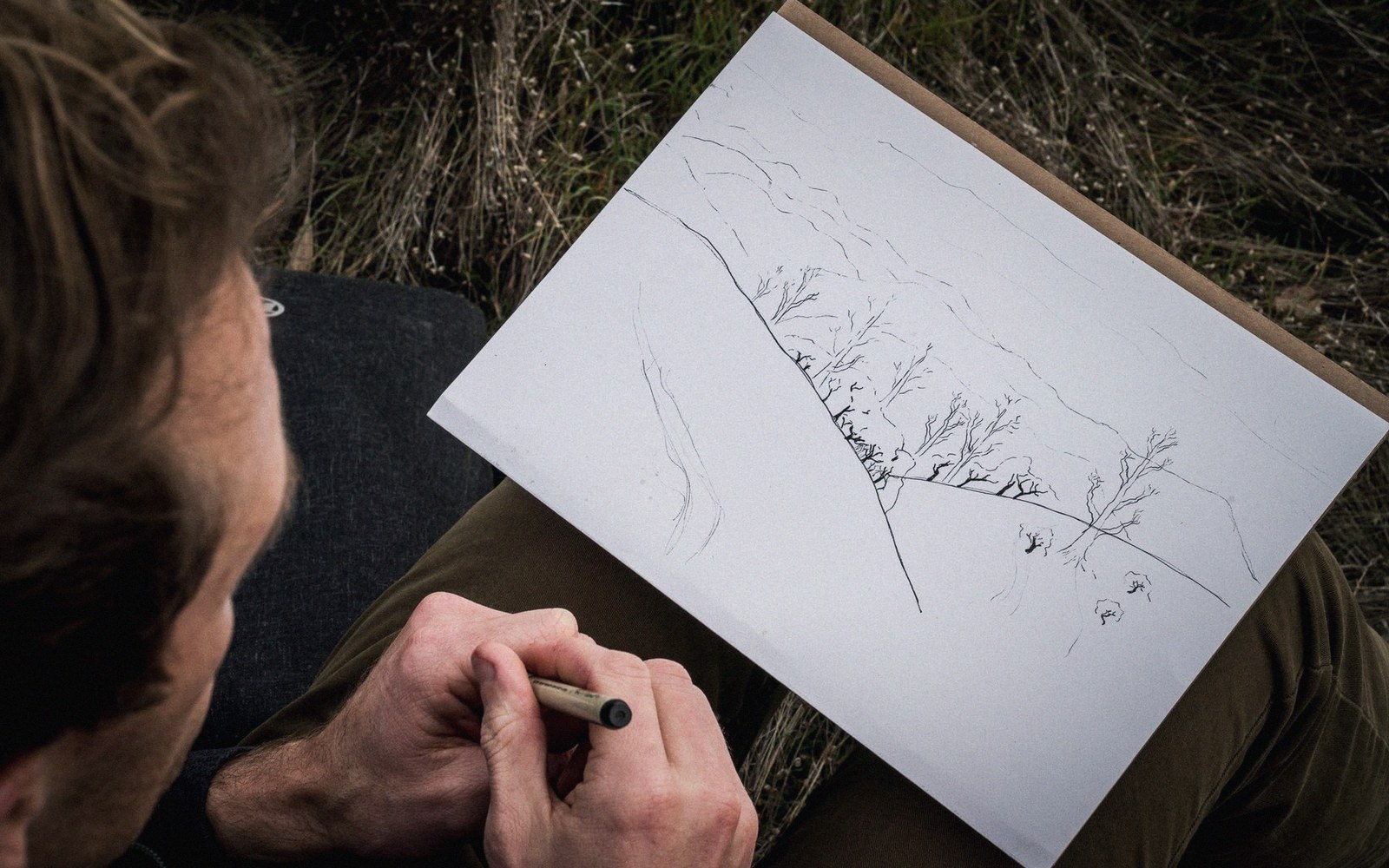
The animal will not cooperate, and that is the whole problem
This forces a discipline that no other kind of drawing quite demands. The working method is not one extended observation but a rapid series of incomplete ones, each capturing something different, each stored — on paper or in memory — and combined later. Knowing what to grab in each fragment, and how to assemble fragments that were never simultaneous, is the technical core of drawing from life.
The structural note and the memory pass
The first thing a practiced eye goes for is not surface but structure: the angle of the spine, the relationship of head to shoulder, the weight distribution through the legs. These are the decisions the animal has already made, and they carry the whole character of the moment. A heron standing in cold water holds itself differently from a heron that has just landed; a deer grazing has a different topline from one that has lifted its head to listen. The structural note — often no more than a few lines, sometimes just a gestural mark — fixes the essential posture before it changes.
What comes next depends entirely on how long the animal stays put. If it holds, the artist pushes into secondary detail: the angle of a wing, the placement of an ear, the way fur or feather lies across a particular joint. If it moves, the artist does something harder: keeps looking rather than drawing, building a memory image precise enough to annotate the original mark when the animal settles again, or returns to a similar position. This memory pass is not guesswork. It is trained retention — the deliberate practice of holding observed shape long enough to transfer it. Artists who work seriously from life develop it the way musicians develop relative pitch: slowly, through repeated failure.
The return visit is the third phase, and it is what separates a finished drawing from a field note. Animals are not random; they have routines. A bird returns to the same perch; a mammal follows the same path to water. The artist who knows the subject's habits can build a composite picture across multiple sessions, each visit supplying what the last left unresolved. The result may look like a single observed moment but is in fact a synthesis — the posture from Tuesday, the head detail from Thursday, the light condition matched by waiting for equivalent cloud. Field sketches as primary documents make this assembly process visible: a working page shows the same subject in three attitudes, partial notes, a separate study of the foot, an arrow to remind the eye where the shadow fell.
Why the picture convinces
The paradox is that drawing assembled this way — from dozens of incomplete looks — can carry more authenticity than a drawing made from a photograph, which offers every detail simultaneously but already flattened, already composed, already frozen. The life-drawing artist is forced to understand what they are looking at because they cannot rely on the image to supply what their eye missed. If the head turns before the bill is resolved, the artist must either already know how that bill sits, or go back and check. This enforced engagement with anatomical logic means errors are structural rather than surface — and structural errors are the ones experienced viewers detect fastest.
The quality the best from-life work has — a sense that the animal is about to move rather than already stopped — comes precisely from this method. No single observation was long enough to get everything; the result is a drawing where every part was hard-won. That difficulty leaves a trace. Not in visible sketchiness, necessarily, but in a quality of attention that a copy of a photograph rarely achieves, because copying does not require the same understanding. The animal withheld itself, and the drawing is what the artist managed to take despite that.
Artists who work seriously from life develop it the way musicians develop relative pitch: slowly, through repeated failure.