Presence Without Performance
There is a painting by Bruno Liljefors — sea eagles over a fjord, the birds half-lost in the grey of sky and water — that does something almost no wildlife painting does. It refuses to show you anything. The eagles are not performing. They are not posed at the apex of a stoop or spread-winged for identification. They are simply there, as weather is there, as the light off cold water is there, and if you look away you might lose them entirely in the tonal wash of the picture. That is the point.
Liljefors was born in Uppsala in 1860 and died in Stockholm in 1939, and in those seventy-nine years he produced a body of work that still has no real equivalent in the history of wildlife painting. Not because he was the most technically precise — he was not, and did not especially want to be — but because he was the first major painter to treat the relationship between an animal and its environment as the actual subject. Not the animal placed against a background. The animal as an expression of where it lives.
The distinction matters enormously. Most wildlife painting, including much very good wildlife painting, shows you a creature. Liljefors shows you a creature belonging. The eider ducks on a rocky shore are not sitting in front of the rocks; they are the rocks, almost, the same palette, the same broken edge, the same logic of form. When a fox runs across snow in one of his winter canvases, the snow does not stop at the fox's outline. The fox interrupts the snow the way a real fox interrupts real snow — briefly, with that characteristic reluctance of the cold world to accommodate a warm body.
What Sustained Watching Builds
Liljefors spent enormous quantities of time in the field — on the Baltic archipelagos, in the forests of Uppland, in the marshes and coasts that define the Swedish interior. He rented and later owned Bullerö, an island in the outer Stockholm archipelago, and he hunted as well as watched, which gave him a predator's intimacy with animal behaviour: where the quarry holds, how it reacts to wind direction, at what distance it flushes. Hunting knowledge is not separate from pictorial knowledge, in his case. It is pictorial knowledge. The angle of a hare's ears, the precise compression of a bird's body a fraction of a second before it moves — these are things a hunter reads and a painter can paint, but only if the painter has read them too.
A hundred hours in the hide builds a different archive than field sketching ever quite manages: the ordinary posture, the unguarded moment, the animal in the interval between doing things. Liljefors accumulated that archive over decades, and you can see it in the work — not in the drama, which he deployed carefully and sparingly, but in the neutral moments. A sea eagle perched doing nothing. Eiders sleeping. A fox sitting. These ought to be boring paintings, and they are anything but, because the idleness is anatomically specific, behaviourally exact. The bird is not generically resting; it is resting in this weather, at this season, in this posture that any serious watcher of sea eagles will recognise immediately.
Liljefors wanted the second kind of knowledge, and the only place to get it is from the living animal.
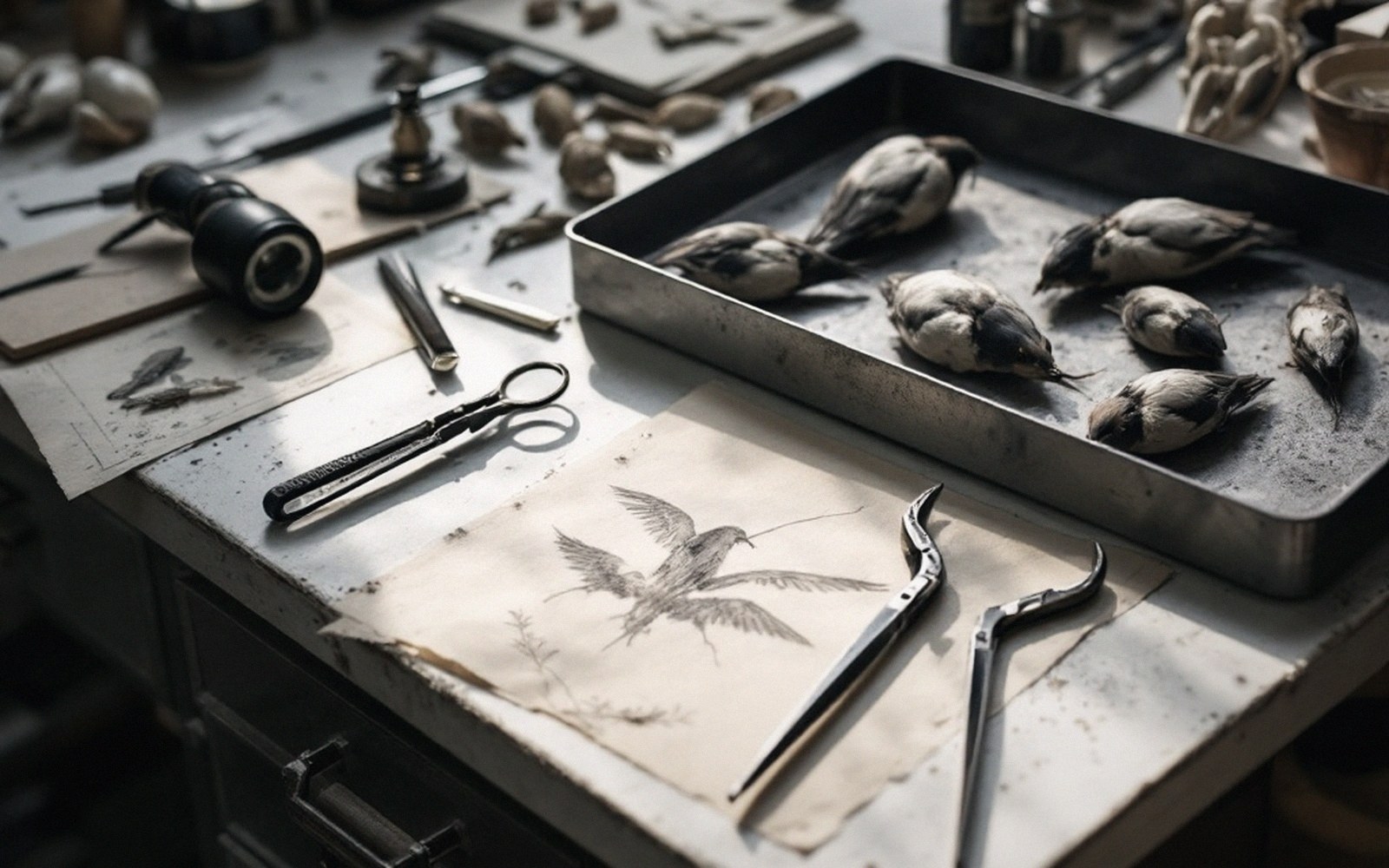
He worked from life first and memory second, which sounds obvious as a method but is rarer in practice than it sounds. The photographs that would later colonise wildlife art as primary reference were not yet available to him in any useful form, and prepared specimens — the study skin, the mounted bird — he treated with the scepticism they deserve. A taxidermied raptor tells you the feather pattern. It does not tell you how the head sits on the body when the bird is cold, or how the wing lies when the bird is merely waiting rather than being displayed. Liljefors wanted the second kind of knowledge, and the only place to get it is from the living animal.
The Technique of Dissolution
The pictorial method he developed to express this was, by the standards of academic natural-history illustration, almost dissolute. Edges go soft. Backgrounds are not subordinate; they push back with full tonal authority. The treatment of fur and feather is summary rather than exhaustive — he was not counting primaries or mapping pelage direction, but finding the visual gesture that makes the eye believe it is looking at down, or at dense winter fur, without labouriously transcribing every element. This is impressionist technique in the service of ecological truth: the bird in distance and atmosphere looks like this, not like a specimen laid on a white card.
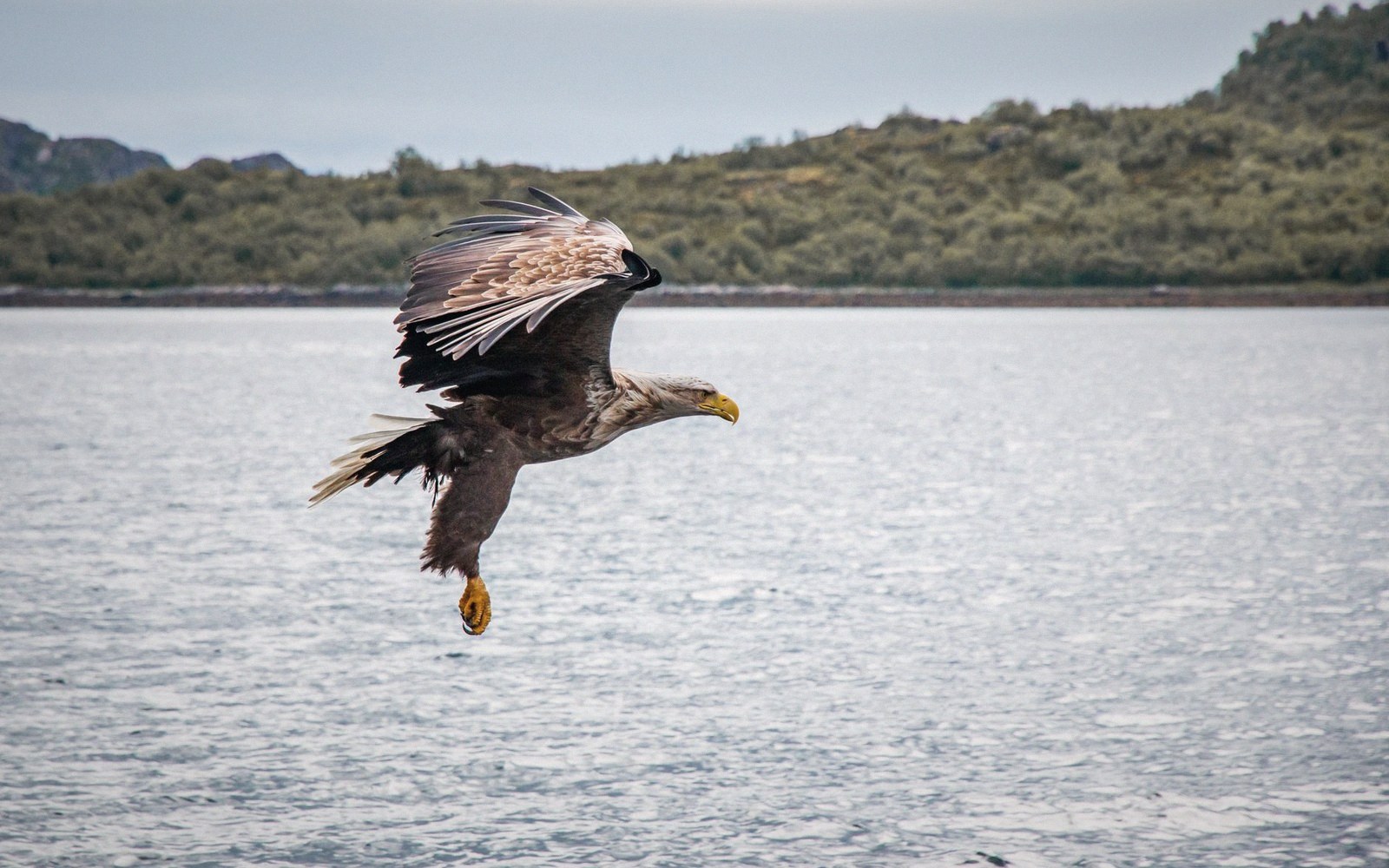
The sea-eagle paintings are perhaps where this is most fully achieved. Haliaeetus albicilla — the white-tailed eagle, an enormous, somewhat ungainly bird in life, not the clean heraldic shape that formal wildlife painters tend toward — appears in Liljefors's work as it actually appears over Nordic water: massive, purposeful, and partly consumed by sky. He catches the flattening effect of overcast light on a large pale bird, the way the underwing detail disappears into brightness from below, the slight heaviness around the tail that distinguishes this species in the air from any other large raptor. These are observational truths, not technical flourishes.
What he does not do is what most painters of eagles cannot resist doing: he does not give the bird a face. Or rather, he does not give it an expression. The sea eagle in a Liljefors canvas is not communicating with you. Its eye is not catching yours. It is looking at the water, or it is not looking at anything in particular, because it has not noticed you — and the sensation of not being noticed by a wild animal, of watching without being seen, is central to the emotional register he is working in. This is a painting about what it is to be in the presence of something that has no interest in you whatsoever, and that is a far more accurate account of wildlife watching than the eye-contact drama most painters manufacture.
Why He Is the Rupture
Wildlife art has a before and after, and Liljefors is where the rupture sits. Before him, the governing logic was essentially taxonomic: the painting's job was to show the animal fully and correctly, in a posture that displayed its characteristic features, against a background that established its habitat without competing with it. This tradition produced magnificent work — the great plates of the nineteenth-century natural-history books have real grandeur — but it is a tradition rooted in display rather than observation, in the specimen rather than the living creature.
What Liljefors proposed, and demonstrated with sustained conviction over more than half a century, was that observation is the discipline and display is the evasion. An animal shown at its most visible, in its most characteristic posture, from the most informative angle, is an animal that has been curated for you — and curation is the opposite of watching. Watching is what happens when you wait long enough, still enough, that the animal forgets or never knew you were there. What you see then is not the identifying pose. It is the actual life of the animal, which is mostly ordinary, often half-concealed, and frequently neither dramatic nor particularly well-lit.
He painted that. Not exclusively — he painted stoops and kills and the full predatory drama, and he painted them brilliantly — but he understood that the drama only means something if the ordinariness surrounds it. A fox killing is significant because you have watched the fox not killing, doing nothing, being cold and unremarkable in a field. The sea eagle plunging is shocking because you have seen it simply being a very large bird aloft over grey water, and the shift from one state to the other carries the full weight of what a predator is.
That is what illustration, however accurate, cannot achieve on its own: the before and after of a life, the animal as a continuous presence rather than a selected moment. Liljefors built that continuity into single canvases, which is the harder trick, and he did it because he had seen it — really seen it, at length, from stillness, without the animal knowing he was there.