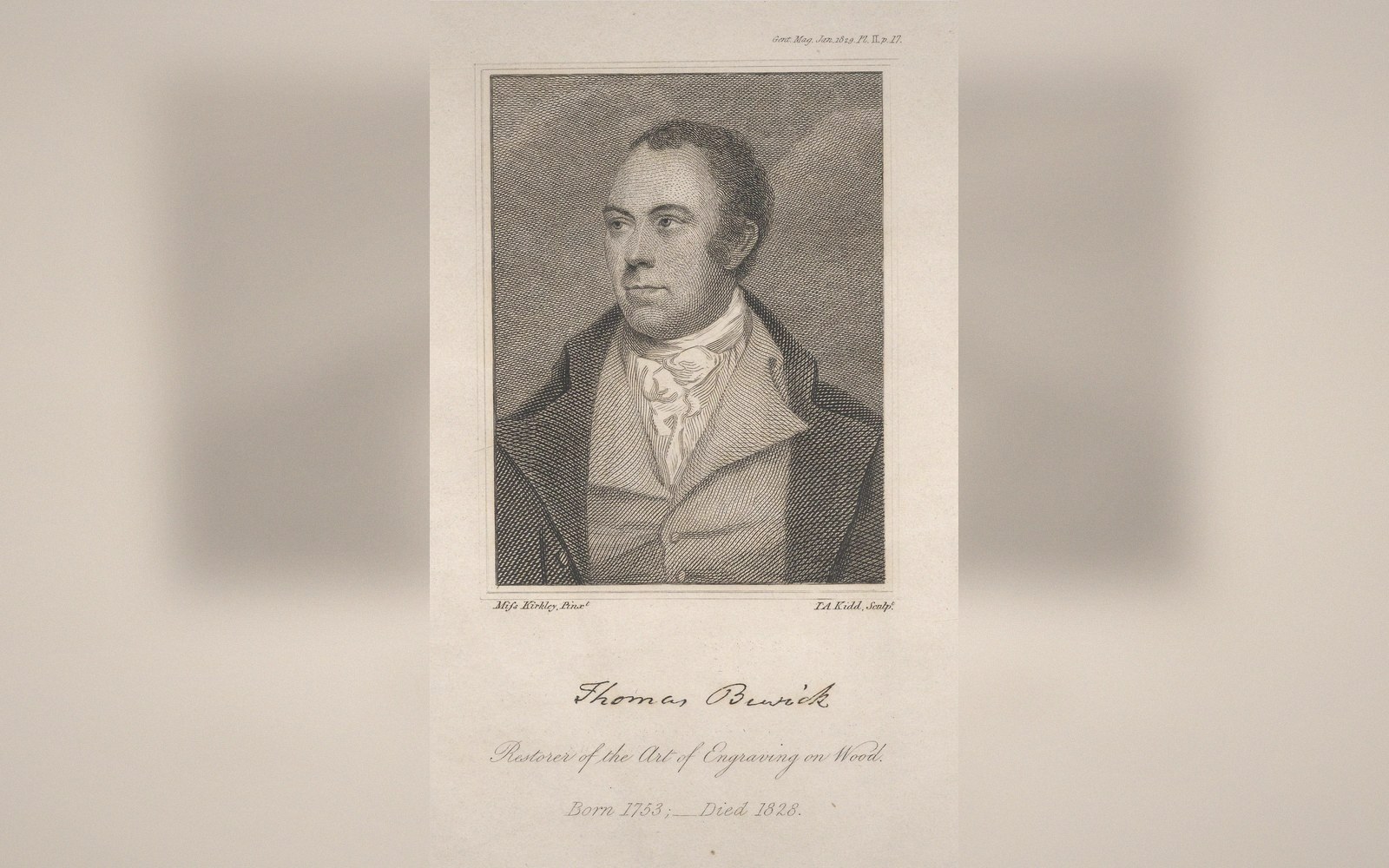
How end-grain boxwood changed what a naturalist could afford to look at
The distinction that matters is between the relief woodcut — cut along the plank, black line drawn out of white — and end-grain engraving, worked across the face of a cross-section, almost always in boxwood because box grows slowly enough to be nearly stone-hard, fine enough to accept a graver's finest line. In a relief woodcut, the knife takes away what is not wanted and leaves a raised surface that holds ink; the natural tendency of the medium is toward bold, flat black line. In end-grain engraving, the burin is used to cut white out of a field of black: every mark the engraver makes is a removal of ink, not an addition. The starting position is solid black; every highlight, every modulation of tone, every wisp of feather or fur is cut into that darkness. The tonal thinking required is the inverse of drawing on paper, and it rewards an artist who thinks in mass and light rather than in outline.
The tonal revolution copper could not afford
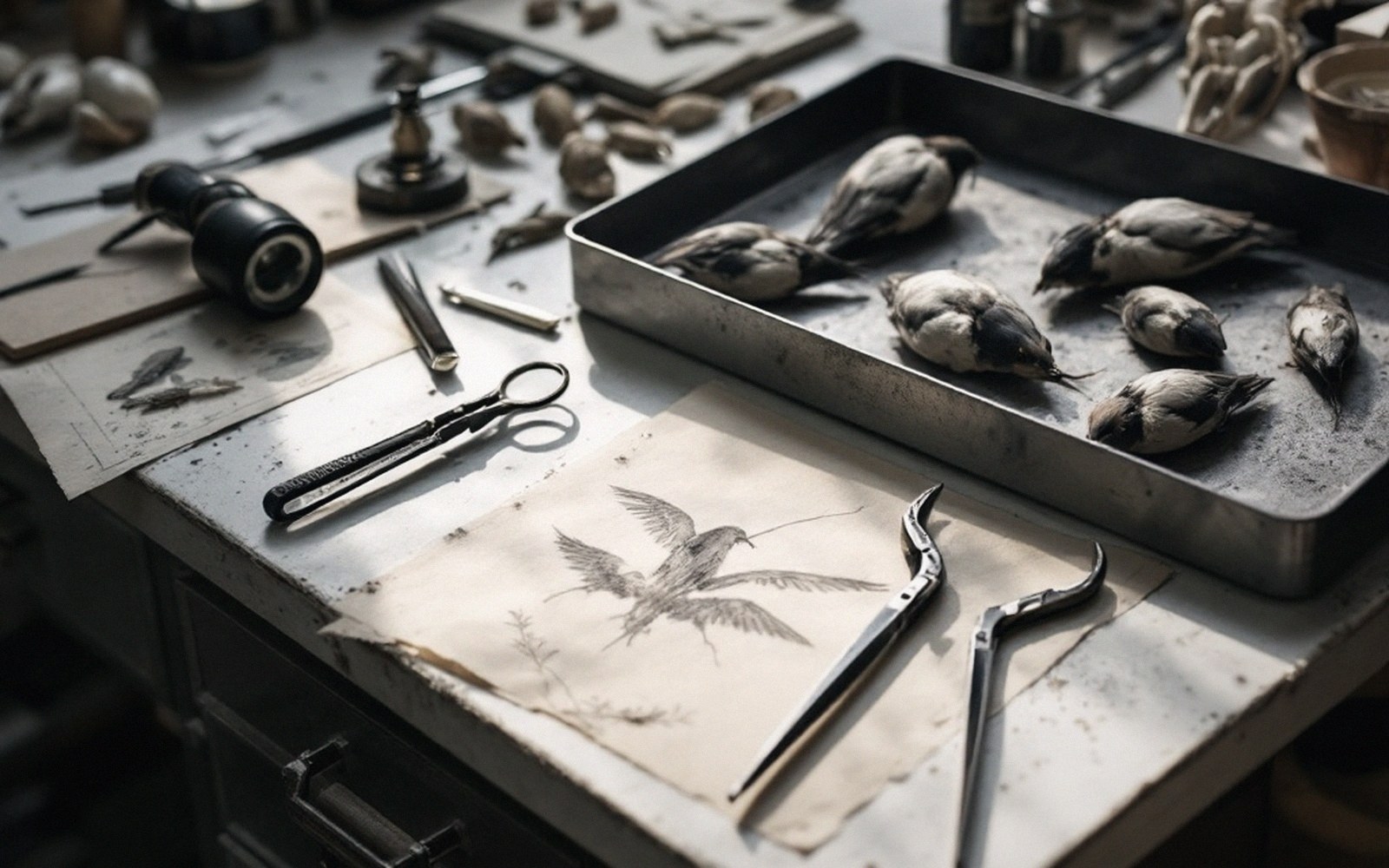
Copper engraving, the prestige medium of natural history illustration from the mid-sixteenth century onward, is an intaglio process: the line is incised into the plate, filled with ink, and transferred under pressure to dampened paper. A skilled copper engraver could produce extraordinary detail and a wide range of tone through cross-hatching, stipple, and the controlled swell of a burin line. What copper could not do was be cheap. A copper plate wore; it required re-touching or re-engraving after relatively few impressions; it could not be stored in type and re-used conveniently alongside text; and the separate printing pass it demanded — intaglio printing is done at different pressure, with different inking, than relief letterpress — meant that illustrated natural history was a luxury object. John Gould's folios, produced in the mid-nineteenth century, were hand-coloured lithographs sold to subscribers who could afford them. Eleazar Albin's earlier watercolour-based engravings were similarly expensive. The audience for illustrated natural history remained narrow precisely because the production process made it so.
Bewick's History of British Birds — the Land Birds volume in 1797, the Water Birds in 1804 — reached a different audience not because it was cheaper in a casual sense but because the economics of end-grain wood engraving made a moderately priced octavo genuinely possible. The blocks printed with the type. Impressions could run to thousands without significant degradation. The book could be bought by a country clergyman, a schoolmaster, a curious farmer. Gilbert White's Natural History of Selborne had already demonstrated that appetite for natural history existed well beyond the wealthy collector; Bewick gave that appetite pictures it could actually afford.
But the reach would have been limited if the images were merely adequate. What made them matter artistically is what the medium demanded of their maker.
What working white-out-of-black actually requires
A copper engraver works in line — accumulating marks that build toward tone. A Bewickian wood engraver works in light — excavating the dark surface to reveal what the light hits. This is not simply a technical distinction; it changes the relationship between the image and the ground. In an end-grain engraving, tone is built by leaving more or less of the black field intact: a dense texture of cut lines produces grey; a smooth uncut area is solid black; a fully cleared area is white paper showing through. The intermediate tones — the mid-greys of a wet feather, the softer blacks of fur in shadow — are achieved by controlling the spacing, width, and depth of each cut. The graver can be rolled slightly to produce a line that tapers. It can be pushed at varying speeds to control the edge. A fine tint tool cuts parallel lines at a regular interval. A multiple tool cuts several parallel grooves in a single pass. All of these produce tone, and the tonal range available on end-grain boxwood is genuinely wide, wider than a woodcut and competitive with copper at the mid-tones — though copper's finest lines still exceeded what the boxwood surface could resolve.
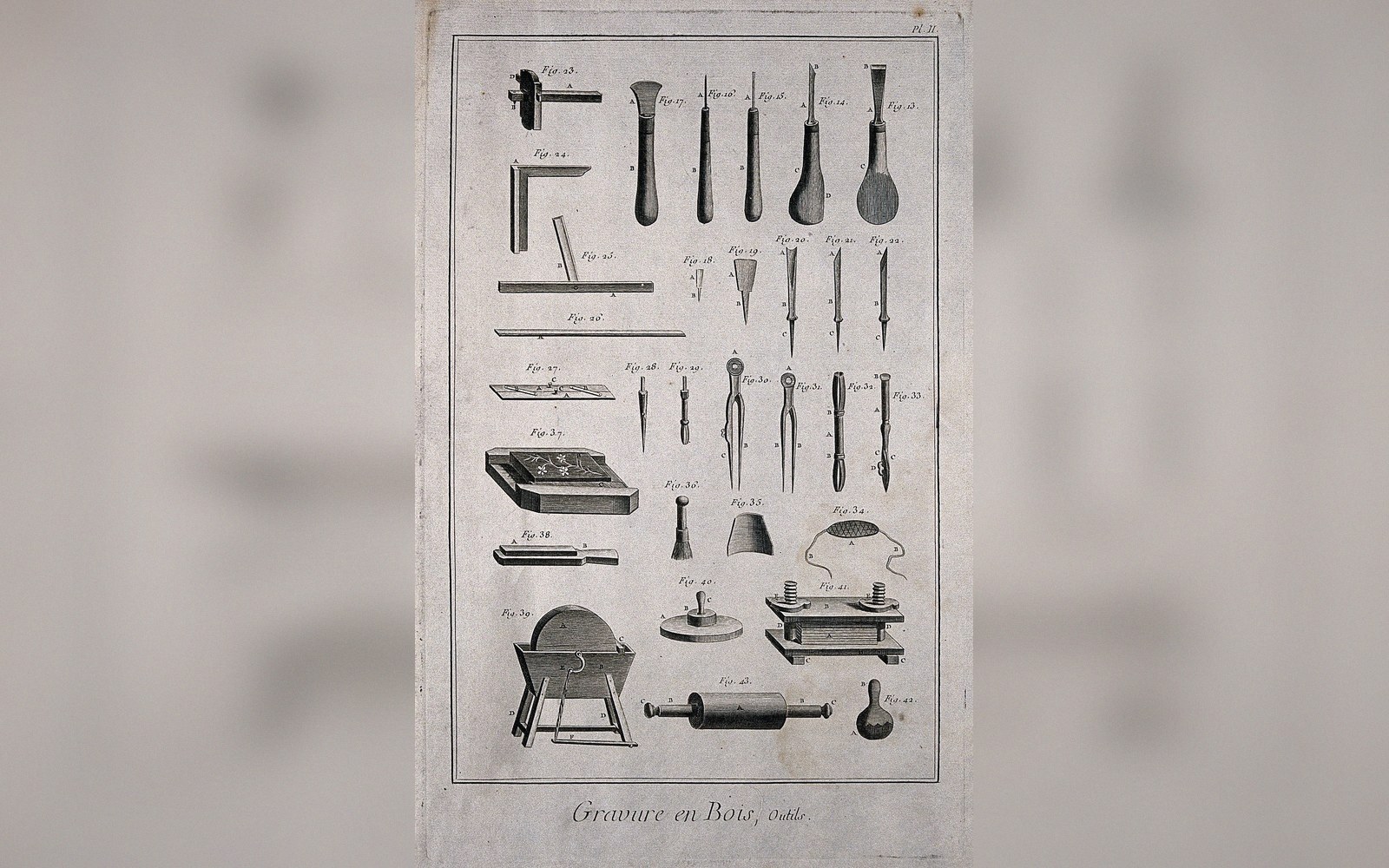
What Bewick added to this technical repertoire was an understanding of how animals actually sit in light. His birds are not outlines filled with texture. They are forms in which the white-out-of-black method mirrors the actual experience of seeing a bird against sky, or in shadow, or in the oblique winter light of County Durham. The stippled highlights along a kingfisher's back, the fine transverse lines that give a woodcock's underside its soft banding, the near-solid black of a rook against a pale field — these are tonal decisions made by someone who looked at the animals themselves, and who then made the medium produce what observation had stored. The tail feathers and bill of his kingfisher carry individual barb structure; the water in his vignettes has surface tension. None of this comes from working at a specimen alone.
The audience for illustrated natural history remained narrow precisely because the production process made it so.
It is worth noting what the vignettes at the foot of each page contribute. These small images — landscapes, country scenes, occasionally comic or memento mori in character — are often cited as charming add-ons, genre material included for pleasure. They are also exercises in the range of the medium: each one rehearses the handling of a different kind of light, a different surface, a different atmospheric depth. A moonlit barn, a man fallen from a wall, a ploughteam in fog: these are tonal studies in the discipline of working black. They kept Bewick's eye calibrated, and they kept his cutters — he trained a workshop — thinking across the full tonal scale rather than settling into formula.
The discipline of the single-pass medium
There is something that end-grain engraving shares with transparent watercolour that it does not share with copper: the absence of an easy corrective path. A copper plate can be burnished down and re-engraved; errors can be partially disguised. A boxwood block, once cut, has been cut. The white cannot be put back. This concentrates decision-making in the same way that watercolour and the single chance concentrates it for the painter: the hand must be committed before it moves. An engraver who hesitates mid-stroke produces a line that wobbles at its hesitation point, and on a block read at close range those flinches are visible. Bewick's blocks, examined under magnification, show remarkably consistent line quality — the product not of unusual physical steadiness but of a working method in which the image was understood before the graver touched the wood.
His preparatory practice mattered here. The design was drawn onto the block in ink or pencil — sometimes transferred from a drawing, sometimes drawn directly — and the engraver read that drawing as a set of tonal masses rather than as a line-drawing to be copied. The line drawing on the block disappears as the engraver cuts; what remains is the tonal structure that the engraver has built. This inversion — the original marks are destroyed in the making of the image — is one reason that studying Bewick's technique requires looking at the prints rather than at preparatory drawings, of which relatively few survive.
The blocks themselves do survive, in considerable number, at the Tyne & Wear Archives & Museums, where they can be examined and have been printed from in the modern era. Looking at the blocks and the prints together clarifies what the medium does: the blocks are pale objects, the cut surfaces bright wood, the uncut relief surfaces showing the black of the ink-bearing layer. The prints are mirror images of the blocks: the cut, pale areas print white and the uncut, inked areas print black. To read a block correctly, you must mentally reverse it, and in that reversal you begin to understand the sustained tonal thinking the work required.
What the medium ultimately did — what Bewick's application of it proved — was that tonal naturalism in natural history illustration did not require copper, did not require hand-colouring, did not require the workshop of a Gould or the subscription list of an Audubon. It required a dense block of boxwood, a sharp graver, and an engraver who had looked at a kingfisher closely enough to know where the light goes.