What the Medium Takes Away
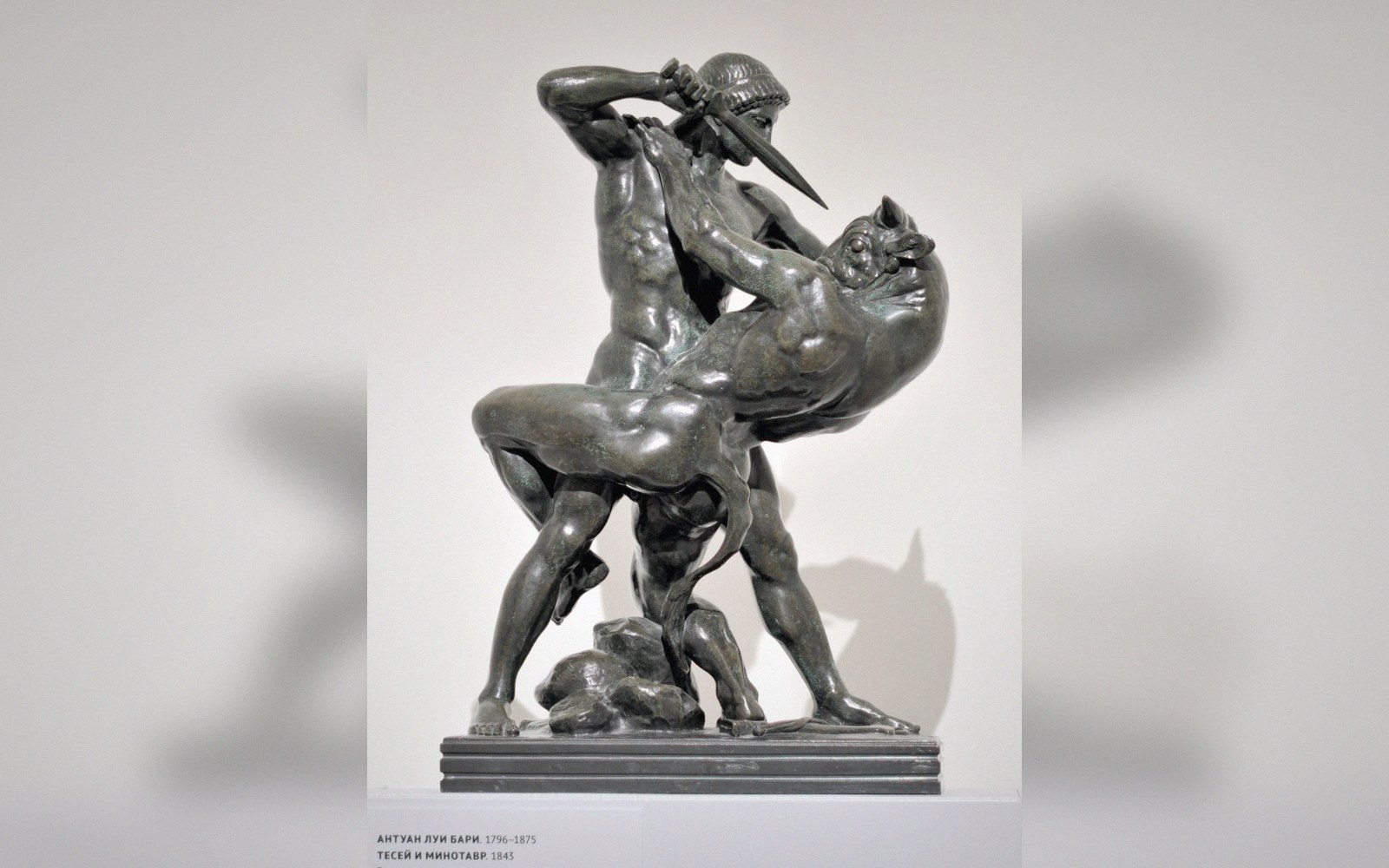
A painting of an animal can cheat in ways a sculpture cannot. Colour carries mood; a warm wash suggests fur without describing it; a lost edge at the shoulder dissolves the problem of depicting muscle sliding under skin. Bronze refuses all of that. Cast metal is one colour — the colour of its patina, which is the artist's choice only in the broadest sense — and its edges are whatever the modelling made them. Nothing is implied. Nothing is soft-focused into plausibility. The form either reads, or it does not.
This is why the nineteenth-century French sculptors who gave themselves to animal subjects — the animaliers, a term that stuck — developed a discipline of anatomical looking that was, in its own register, as rigorous as anything happening in the academies. Antoine-Louis Barye, the movement's founding figure, worked from carcasses supplied by the Paris abattoirs and made regular use of the dissection rooms of the Jardin des Plantes, where the Muséum National d'Histoire Naturelle held its menagerie. He measured. He peeled back skin. He understood that a lion's shoulder blade rides differently from a horse's because the function is different — and in bronze, that difference had to be expressed as a change of plane, not a change of tone.
Mass as Argument
The animaliers' central problem was one that sculpture always sets and painting often dodges: what is this animal actually doing with its weight? A painted leopard can crouch on a flat canvas, its mass never quite committed to any surface. A bronze leopard has to crouch on something, and the crouch has to be structurally coherent — the haunches loaded, the spine compressed, the forepaws placed where they would actually take the shift of centre of gravity if the spring came. Barye's predator groups, particularly his lions and tigers taken mid-action, show the working through of this problem obsessively. The musculature is not decorative surface texture applied over a generic feline shape; it follows the actual function of each muscle group, which meant Barye had to know what that function was.
Alongside Barye, sculptors including Pierre-Jules Mêne, and Rosa Bonheur in her lesser-known work in three dimensions, brought horses and stags and hounds into the animalier repertoire. Mêne's horses in particular reward close looking: the difference between a standing horse whose weight is actually distributed across three legs — one hindleg resting, fetlock dropped — and one that merely looks horse-shaped is something his surfaces consistently get right. The resting hindleg is not a detail of realism for its own sake; it is proof that the sculptor understood where the skeleton was underneath the bronze.
The animaliers made pieces intended to be read against light from multiple angles, which meant the profile at every rotation had to hold.
Silhouette carried the rest of the argument. The animaliers made pieces intended to be read against light from multiple angles, which meant the profile at every rotation had to hold. A poor silhouette reads as a blob of vaguely biological form. A good one — and Barye's large-scale seated cats achieve this almost without exception — communicates species, posture, and tension before the viewer has moved close enough to read any surface detail. This is not an accident of artistry but a deliberate structural priority: silhouette first, detail second.
The Source and Its Limits
Working from dead animals gave the animaliers accuracy at the level of proportion and skeletal structure, but the same limitation that haunts every painted work from a dead specimen applied here too. A carcass does not show weight-bearing. Musculature slackens; the fascial tension that gives a living cat its taut, dangerous quality dissipates within hours. Barye compensated through careful study of live animals in the Jardin des Plantes menagerie, making wax sketches from observation before refining them against measured carcasses — a workflow that produced, in the best pieces, something a photograph of a taxidermy mount never quite achieves: the sense of a body that could move.
The casting process itself imposed final decisions. Lost-wax (cire perdue) casting, used for the finest editions, reproduced the modelled surface faithfully; sand casting, used for cheaper commercial runs, softened it. The patination — brown, black, green, reddish — was applied with heat and chemicals after casting and was the closest thing to a colour decision the sculptor made. It was consequential: a dark, even patina flattens surface incident; a varied one, lighter on raised planes and darker in recesses, reads like light falling on real form.
What the animaliers proved, at their best, is that the removal of colour and edge is not a constraint to be overcome but a clarifying pressure. When you cannot suggest fur, you must understand it. When tone cannot do the work of form, form must do it alone.