The Problem Is the Point
Watercolour is commitment in solution. Once a wash of colour sits on dry paper and dries, the pigment is locked into the tooth of the sheet, and lifting it — even with a damp brush, even immediately — pulls the fibres and leaves a ghost. Repaint over the ghost and you have a passage that reads as worked, which in this medium is the same as saying it reads as wrong. Oil paint lets you scrape back to bare canvas. Gouache lets you lay opaque colour over a mistake. Transparent watercolour does neither. The discipline is architectural: you build from light to dark, you plan your whites before you touch the paper, and you make major decisions about tonal structure in your head, or in pencil, or in a rapid monochrome study — before any colour goes down. That sequence, more than any property of the pigment itself, is what the medium demands.
For an artist painting animals, this is simultaneously a constraint and a clarification. The hesitation that ruins a watercolour — the repeated small marks in the same patch, the overworked edge, the mid-process correction — is the same hesitation that produces a lifeless picture regardless of medium. Watercolour simply makes the failure legible. A painter who has genuinely understood the structure of a wing, the curvature of a shoulder, the tonal logic of a back-lit flank, can move through those passages quickly and cleanly. One who hasn't will spend time on them, and the time will show.
What Feather and Fur Actually Need
Both feather and fur share a property that suits transparent watercolour precisely: they are surfaces of layered, translucent structure. A bird's body feathers are not a solid colour applied to a shape; they overlap in a sequence of overlapping planes, each slightly different in hue, each catching the light differently depending on angle. Fur works similarly, individual hairs read collectively as a tone that shifts across the body, paler at the tips, deeper in the shadows between. In both cases the visual effect is one of luminosity — light appears to come from inside the surface rather than to sit on top of it.
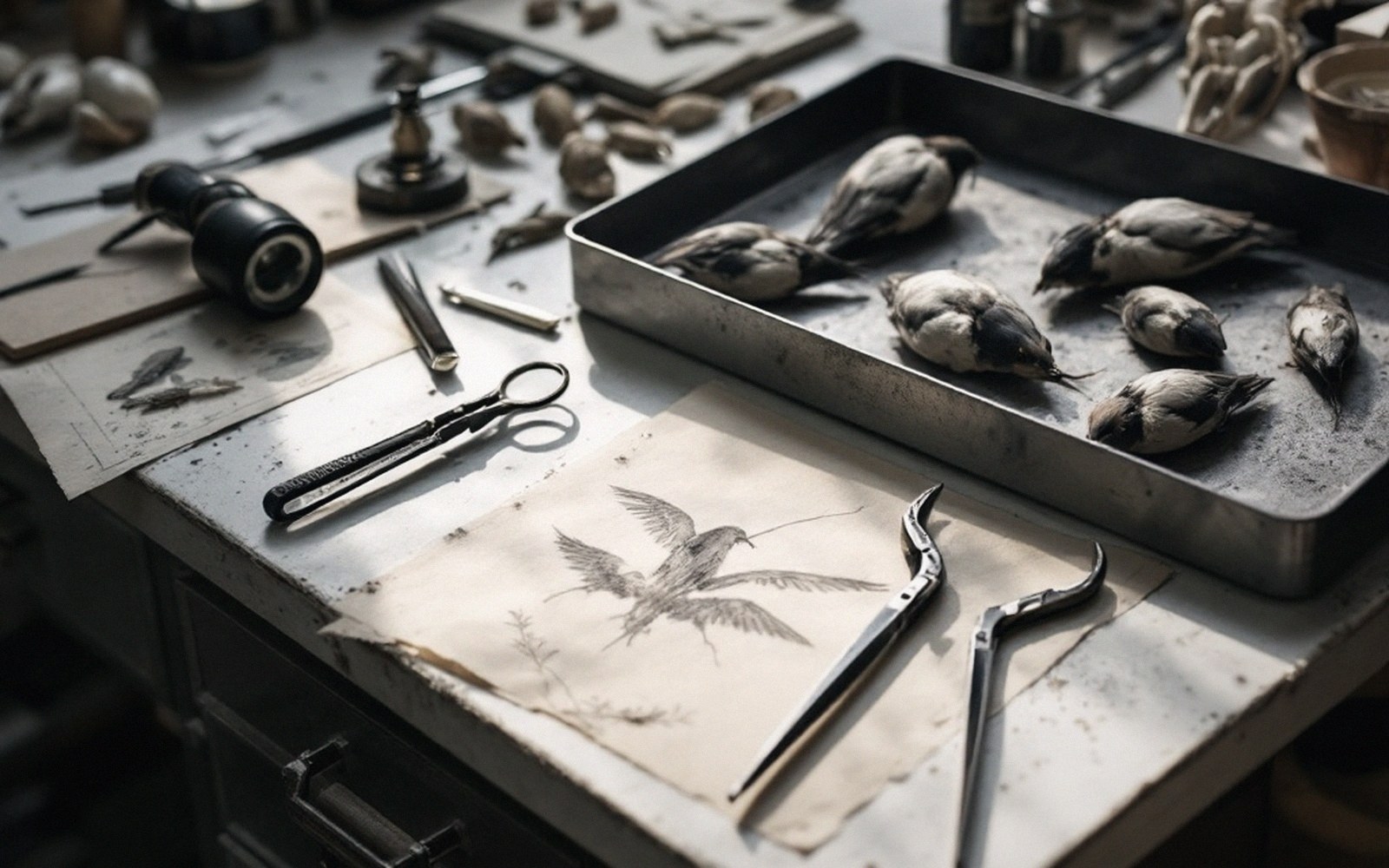
This is the optical property that transparent watercolour can replicate and opaque media frequently cannot. A sequence of carefully laid washes — each one dry before the next is added, each one modifying rather than obscuring what is beneath — builds exactly the sense of layered translucency that a feathered or furred animal actually possesses. The white of the paper, working through successive washes, acts as internal light. When the method is working, the result does not look painted. It looks like the thing.
Repaint over the ghost and you have a passage that reads as worked, which in this medium is the same as saying it reads as wrong.
The specific challenge is the pale areas: the white of a barn owl's underparts, the pale cheek patch of a goldfinch, the cream belly fur of a stoat in summer coat. In transparent watercolour these are not painted — they are reserved. The artist decides, before the first wash, where the light falls, and leaves the paper bare. That decision, made in pencil or in the mind's eye, is irreversible. If the reserved white turns out to be slightly the wrong shape, you can add a tiny amount of body colour in extremis, but the surface will read differently and the eye will find it. The paper can feel the lie.
Before the Brush
What separates a watercolourist who can paint animals convincingly from one who cannot is almost entirely what happens before the brush moves. The preparatory drawing — not necessarily elaborate, sometimes barely a whisper of pencil line — must encode the major decisions: the silhouette, the tonal distribution, the fall of light, the key structural landmarks beneath the surface. An artist who has spent time drawing from life, accumulating structural knowledge that sits in the hand rather than in a photograph, brings a different kind of readiness to the paper than one who is translating an image in real time. The medium rewards the former and charges the latter interest at a punishing rate.
Speed in watercolour is not the enemy. Competent watercolourists work fast. But the speed is not haste — it is the release of accumulated preparation into a single uninterrupted action. The wash that renders a hawk's mantle in five seconds represents, in practice, five years. The medium is ruthless about this. It shows what you know, shows what you don't, and does not allow the slow negotiation between painter and surface that most other media permit. One shot. Get it right.