The Body on the Wire
Every painting in Birds of America began with a corpse. Audubon shot his subjects, then wired them into posture against a grid — a measured paper backdrop that let him transfer scale precisely to his working sheet. The wire went through the body, into the neck, through the bill if necessary, bending the whole animal into the attitude he wanted: feeding, striking, mid-cry. The method was explicit and unashamed. He described it in his journals, and the results are visible in the plates: birds caught in attitudes that taxidermy of the period could not hold and that field sketching alone could not have delivered. Where other naturalist-illustrators of the early nineteenth century drew from skins laid flat on a table — the distortions of which are well documented — Audubon rebuilt the living posture by brute mechanical means.
The freshness of the specimen mattered enormously. He worked fast, often through the night after a day's shooting, racing decomposition and the collapse of muscle tone. The eye, which he knew would go flat within hours, received particular attention: he recorded its colour and condition immediately, sometimes painting it first. The result, in plate after plate, is the quality that still makes the work startling — the sense of a bird in the instant before it moves, not a specimen in the instant after it was killed, which is precisely what it is.
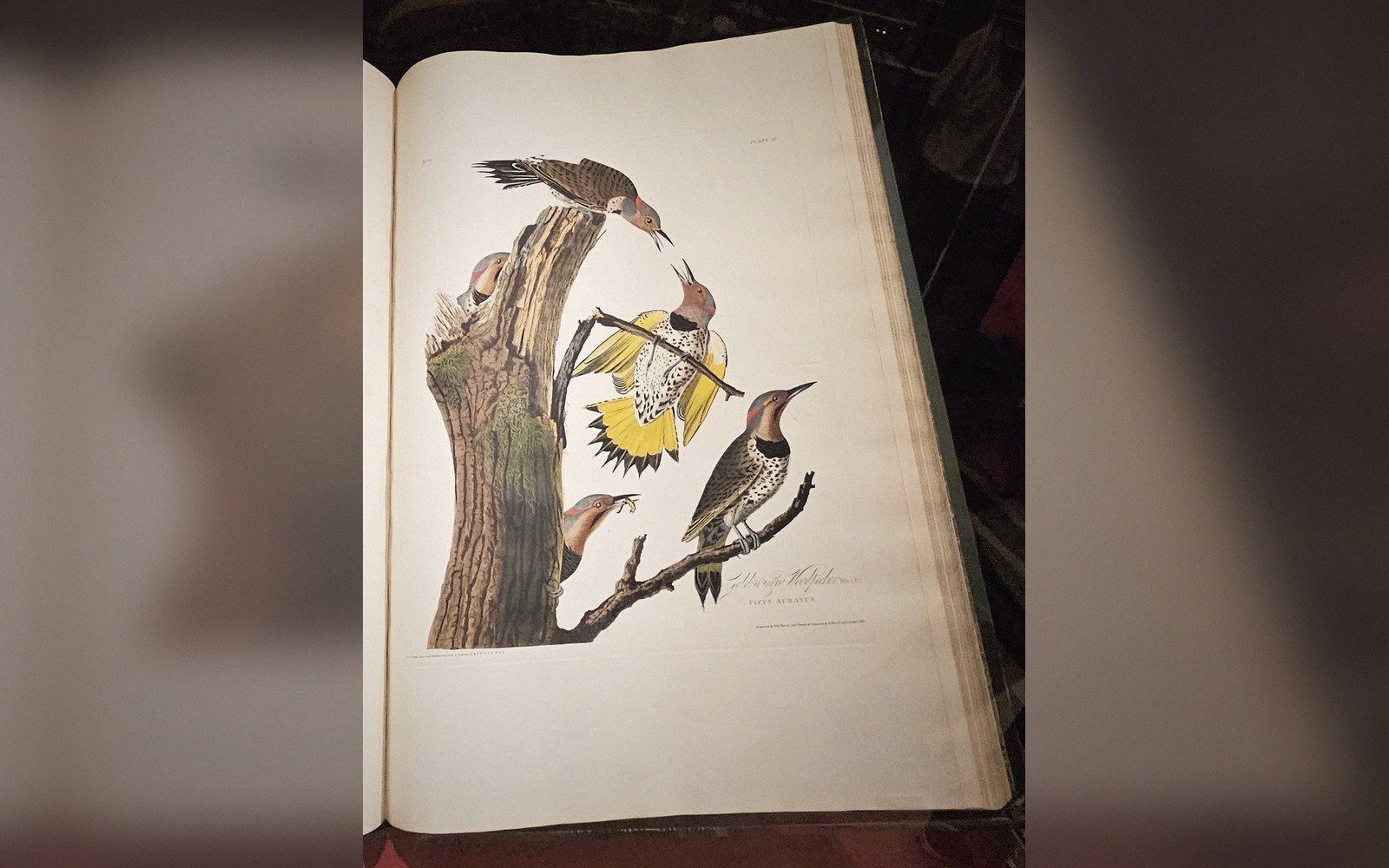
The wire-and-grid method also answered the problem of scale. Audubon had decided early that every bird would appear at life size — every one. This commitment drove every subsequent production decision, because life size for a Trumpeter Swan requires a sheet large enough to contain a wingspan of seven feet or more. The double-elephant folio was not a vanity; it was the only format in which the constraint could be met. Sheets measuring roughly thirty-nine and a half by twenty-six and a half inches, bound into a publication with 435 plates: the mathematics of that ambition determined almost everything else about the enterprise.
The Havell Workshop
Audubon drew in watercolour and pastel on paper, producing originals that had then to be translated into prints. He worked first with William Home Lizars in Edinburgh — ten plates were engraved there — but moved to Robert Havell in London in 1827, and it was the Havell workshop, father and then predominantly son, that produced the remaining four hundred and twenty-five plates. The process was aquatint over etching: the image bitten into copper by acid, with the tonal areas built up through the aquatint grain that gives the technique its particular warmth of texture.
The copper plates themselves were enormous, matching the double-elephant sheet. Working at that scale in aquatint demanded engravers of exceptional competence. Robert Havell the younger — who effectively ran the operation from 1828 — was precisely that. His contribution is not sufficiently acknowledged in the popular history of Birds of America, which tends to treat the plates as direct transcriptions of Audubon's paintings. They are not. Havell interpreted, adjusted, sometimes corrected anatomy where Audubon's watercolour was ambiguous, and made thousands of decisions about where the acid bit and where it did not. The printed line is Havell's line. The tonal structure of every background — the tupelo branches, the Carolina sky, the Louisiana swamp water — came through Havell's hands.
Robert Havell the younger — who effectively ran the operation from 1828 — was precisely that.
Publication proceeded in parts, called numbers, each containing five plates issued to subscribers between 1827 and 1838. The full work ran to eighty-seven numbers, 435 plates in total, representing 497 species as Audubon counted them — a figure later revised by ornithology, since he described some plumages as separate species. Subscribers paid two guineas per number. Maintaining their confidence, keeping them paying through more than a decade, required constant promotion: Audubon's famous showmanship, his American-frontiersman persona performed for British drawing rooms, was partly a fundraising operation to keep the copper plates being bitten.
Colour by the Yard
The prints came off the press in black — aquatint and etching, ink on paper, no colour. The colour was applied by hand, every plate of every copy. The production run for Birds of America is generally estimated at around two hundred complete sets, which means 435 plates hand-coloured two hundred times: roughly eighty-seven thousand individual hand-colouring operations, plus the partial and defective copies that were discarded or broken up. The Havell workshop employed colourists in numbers that varied through the production run. They worked from a pattern plate — a coloured exemplar, prepared to a standard — and applied watercolour according to it, bird by bird, background by background, across the enormous sheets.
The consistency that this system achieved is, on close examination, not total. Copies of the same plate from different periods of the print run show variation in background tone, in the intensity of certain pigments, in the handling of soft-part colour on bill and leg. Some of this reflects different batches of pigment; some reflects different colourists working to the pattern with varying degrees of exactness; some reflects changed colour decisions made by Audubon himself when he visited the workshop and revised the pattern. The work is simultaneously a workshop product and a living document, being corrected and updated across the eleven years of its production. Later numbers sometimes show revisions to plates issued years earlier, the new information fed back as Audubon received criticism from ornithologists or saw additional specimens.
The pigments in use were those of the period: watercolour grounds made from mineral and organic sources, some of which have proved durable and some of which have not. The fugitive colours — certain reds, certain yellows — have shifted or faded in copies exposed to light, so that the chromatic experience of reading Birds of America now depends substantially on the storage history of the copy being examined. Institutional copies held in controlled conditions since acquisition often read differently, sometimes more brilliantly, from copies that passed through auction and domestic use before finding a library.
One Mind, Industrial Scale
The paradox of Birds of America as an object is that it is unmistakably a personal vision and unmistakably an industrial undertaking. The personal vision is evident in the compositional decisions: Audubon almost always chose to show behaviour rather than identification posture. The Great Blue Heron strikes at a fish. The Bald Eagle tears a Catfish. The Passenger Pigeon — now extinct, the plate one of the few visual records of the living bird — appears in a pair, the male's bill at the female's nape, in a posture of courtship feeding. These are not identification plates in the manner of the competing tradition. They are images of animals doing things, and the dramatic staging — the diagonal compositions, the plants used as framing devices and ecological context simultaneously — is consistent across 435 plates in a way that argues for single authorship of conception even where the execution was shared.
The industrial scale is visible in the physical object: the staggering uniformity of the format, the production discipline required to maintain it across a decade, the financial machinery of subscription publication that kept it moving. Birds of America was followed by a text: the Ornithological Biography, five volumes published between 1831 and 1839, co-written with the Scottish naturalist William MacGillivray, which provided the scientific descriptions the plates deliberately omit. The plates themselves carry no text beyond the species name engraved at the foot. They were designed to be looked at.
The full double-elephant sets are among the most valuable printed books in existence, with complete copies now in a small number of institutional collections — the Natural History Museum in London, the New York Historical Society, the Smithsonian, and others — alongside a handful of private holdings. But the work's influence on wildlife art as a discipline operated not through those rarefied original copies but through the octavo edition published from 1840, in which the plates were reduced, lithographed and reprinted at a scale ordinary subscribers and naturalists could afford. It was through that edition that Audubon's compositional habits — the behavioural staging, the ecological framing, the refusal of the identification-pose default — entered the working vocabulary of the illustrators who followed him.
The wire in the specimen's neck, the acid in the copper, the brush of an anonymous colourist in a London workshop in 1833: none of it is glamorous as process. What it produced, in aggregate, is a monument to the idea that showing an animal as it lives requires exactly that kind of labour — mechanical, obsessive, and pursued at a scale that borders on the irrational.