The Pattern and the Line
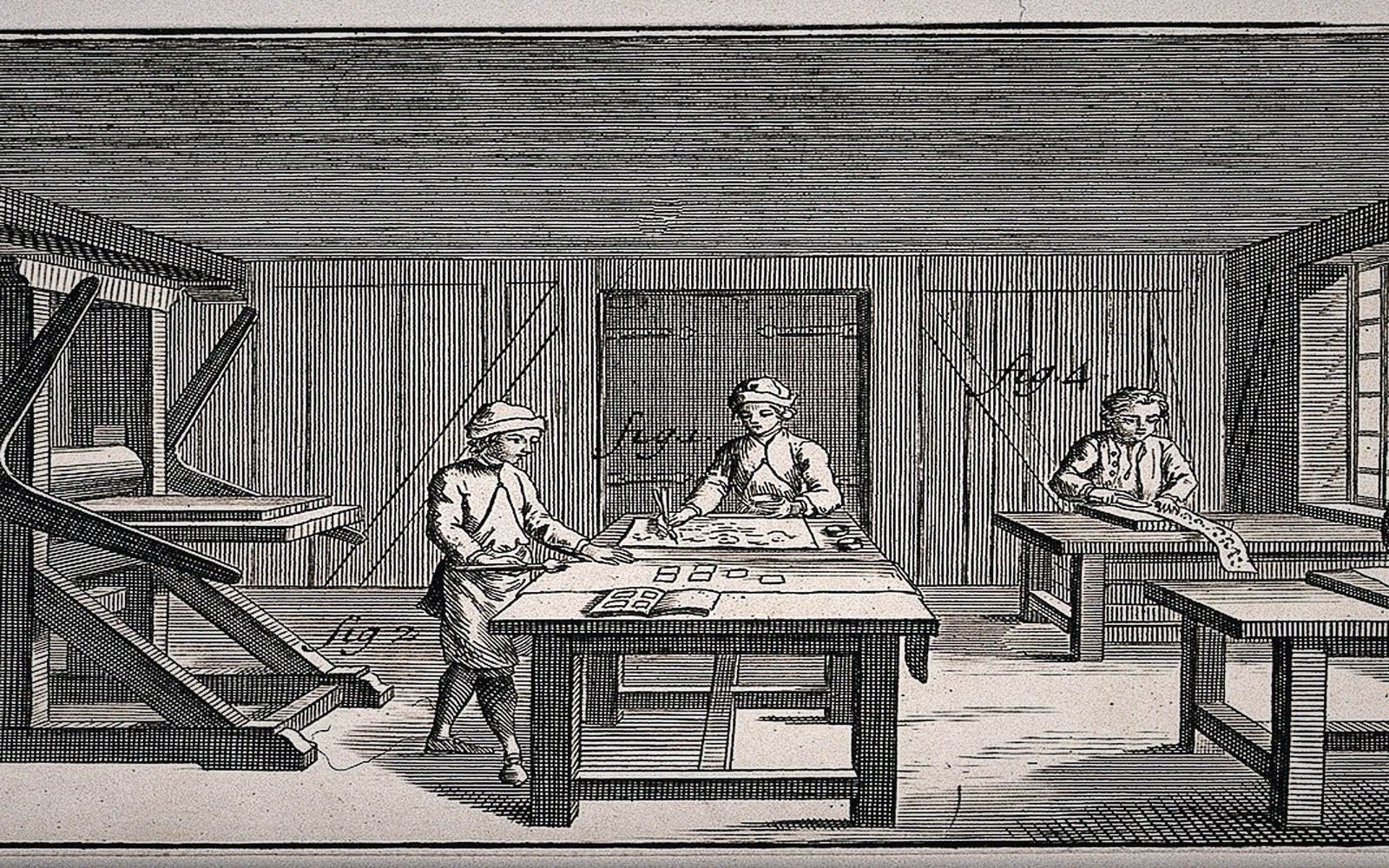
The engraved or etched plate printed in black — the outline, the hatching, the modelled shadow — was the publisher's fixed asset. What turned that grey sheet into a saleable natural history plate was colour, and colour was always applied by hand, wash by wash, with a brush. The process sounds intimate. In practice, it was a small industry.
Every substantial print run — anything from a few hundred to several thousand copies — required a coloured master sheet called the pattern plate, sometimes the proof, against which all subsequent copies were matched. One skilled colourist, often the most senior in the workshop, laid down that single authoritative version. It was the model. Everything that left the shop was supposed to look like it.
The colourists themselves worked in a line, each responsible not for finishing one complete plate but for applying a single colour across every sheet in the run before passing the stack on. First wash: the warm ground of a breast, repeated perhaps four hundred times. Second wash: the grey-green of a wing covert, four hundred times again. The method is essentially factory-line, optimised for speed and, in theory, for consistency. In practice, consistency was the hardest thing to achieve.
Pigment mixed at the start of a session was not identical to pigment mixed three days later, even from the same stock. A colourist's hand tired. The dilution of a wash drifted through the afternoon. The paper's dampness varied with the season. Publishers knew this and inspected sheets against the pattern; some editions carried explicit instructions — thin rules of text in the plate margins specifying the intended tints. But inspection slowed the line, and deadlines were real.
Where a colourist understood, or had been well trained, the wash respected the engraver's modelling.
What the Pattern Plate Could Not Transmit

The line colourist working mechanically through a stack was not making aesthetic decisions; she — and the workforce was very often female — was matching. But matching a pattern plate is not the same as understanding the animal. The distinction shows in the finished prints.
Where a colourist understood, or had been well trained, the wash respected the engraver's modelling. Shadow was reinforced by a slightly deeper value; a highlight was left untouched or barely breathed over. The colour worked with the structure already implicit in the hatching. Where a colourist was simply filling areas of a repeated shape, the wash often obliterated precisely the tonal information the engraver had spent hours cutting. Breast-feather detail — painstakingly cross-hatched to suggest softness — disappears under an opaque body-colour applied too heavily. The plate still reads as a bird. It stops reading as a body.

The pigments used were broadly those of any watercolour workshop of the period: gamboge for yellows, Prussian blue introduced from the early eighteenth century, vermilion for reds, lamp black, lead white in body colour for highlights. Some workshops used Indian ink washes over the printed black to deepen shadows before adding colour. Others worked in pure transparent washes throughout. Neither system was universal, and the results within a single edition could vary enough that two copies of ostensibly the same plate, placed side by side, read as different images.
Why It Matters for Reading the Prints
None of this should be taken as a criticism of the prints themselves, which are among the most extraordinary documents in the history of natural history. It is, rather, a working principle for looking at them. When you examine a plate from a major illustrated work — whether a European ornithological atlas from the eighteenth century or one of the large folio productions of the early nineteenth — you are not looking at a single artist's vision translated faithfully into colour. You are looking at a workshop decision, subject to the drift inherent in any production process.
This matters enormously for anyone trying to read such a plate as evidence about the animal depicted. The engraved line carries information the engraver derived from the original drawing or specimen. The colour carries something more uncertain: the pattern-plate colourist's reading of whatever model she was given, filtered through the speed of the line, the quality of that morning's mix, and the variable eye of whoever held the pattern up to compare. A bright leg on one copy may be a faded leg on another. A saturated mantle on the pattern may have become a washed-out one by copy three hundred.
Collectors have always known that early, well-coloured copies of a great illustrated work are rarer and more prized than later ones. The reason is not sentiment. It is that the pattern colourist's session, and the first passes through the line while pigment was fresh and the model closely studied, produced results that subsequent batches demonstrably failed to match. The glory of the great natural history plate, and its limitation as scientific evidence, share exactly the same cause: the hand, working fast, in a lit room, against a model it could only approximately follow.