Why one joint defeats painters who get everything else right
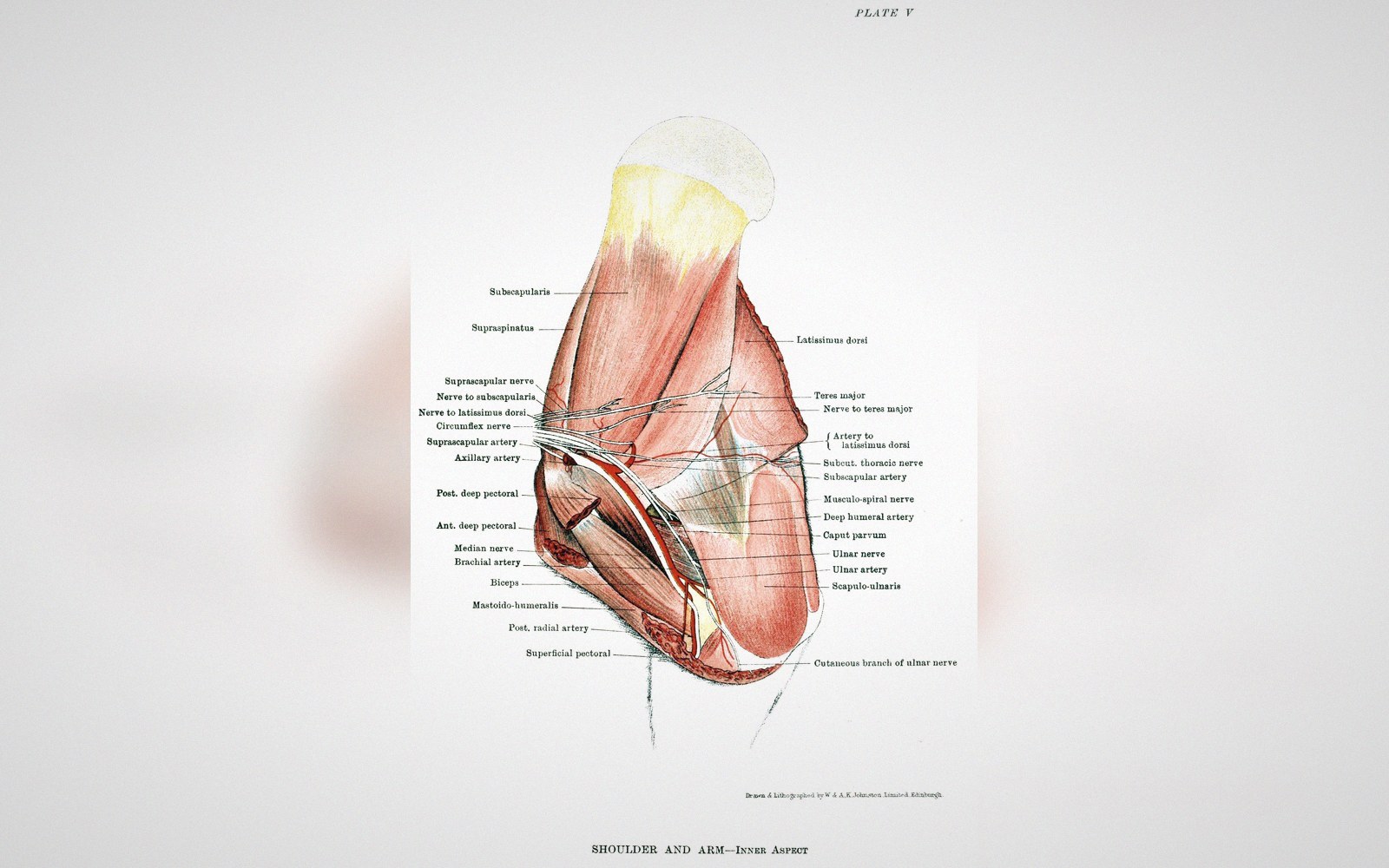
It still is. The equine shoulder is the single joint most commonly misrepresented in animal painting, even by artists who handle the head, the hindquarters and the coat with complete authority. The error is consistent enough to have a characteristic shape, and once you have learned to see it, a wrongly drawn equine shoulder is difficult to un-see. What follows is an attempt to describe both the anatomy and the failure.
What the joint actually does
Begin with a structural fact that surprises most people who have not thought about it: horses have no clavicle. There is no bony attachment between the forelimb and the thorax. The entire shoulder girdle is suspended in a sling of muscles and cartilage — the serratus ventralis being the primary load-bearer — and the scapula can glide, tip and rotate against the ribcage to a degree that a human shoulder, which is bony-anchored at the sternum, cannot approach. This muscular suspension is what allows a galloping horse to absorb impact and extend stride. It is also what makes the shoulder's surface geometry shift dramatically depending on the position of the limb, the loading of the joint, and the tension in the muscles above.
The scapula itself is large and steeply angled. At rest it lies at roughly fifty to fifty-five degrees from the horizontal, its spine running from low on the chest wall up toward the withers. As the leg swings forward in protraction, the lower angle of the scapula swings back and the whole bone rotates, pulling the top of the shoulder forward and dropping the bottom of the scapular spine. As the leg moves back in retraction, the reverse occurs. This is not a small movement. In an extended trot or canter, the visible surface of the shoulder changes shape noticeably between fore and aft positions of the stride. A painter working from a photograph taken at an arbitrary instant of the stride has one snapshot of one configuration. A painter working from a standing horse has a resting configuration that will not be identical to any dynamic configuration. A painter who is not thinking about any of this simply invents a generic shoulder shape and places it on the body.
That generic shape is the error.
The characteristic failure and how to see it
The wrong shoulder appears in two main forms, both rooted in the same misunderstanding.
The first is the flat-plate shoulder: the scapular mass is rendered as a roughly rectangular plane, often slightly shaded, that sits like an appliqué on the side of the thorax. It does not integrate with the neck above or the elbow below; it sits. The edge of the shoulder — the visible ridge of the scapular spine and the overlying trapezius — is often shown as a single curved line that runs too uniformly from withers to elbow, producing a shoulder that reads as a curved panel rather than a complex of shifting muscular surfaces. You see this constantly in decorative equestrian paintings from the seventeenth and eighteenth centuries, in equine bronzes made by sculptors who were great artists but not anatomists, and in much contemporary horse painting where the artist has copied a photograph without understanding what the photograph is showing.
It is what makes the animal's weight feel right, what makes the stride feel possible, what makes the picture breathe.
The second failure is the inflated shoulder: the muscle mass between the point of the shoulder and the withers is rendered as convex — a prominent, rounded mound. This comes from genuine observation of living horses, but from casual observation at rest in poor light. Under certain lighting conditions, and particularly in heavy breeds or well-muscled show horses, the shoulder region can appear full. But the painted version typically over-reads this fullness and places the peak of the convexity too high and too central, so that the shoulder looks like a bolster strapped to the animal's side. The functional ridge of the scapular spine, which should describe a clear diagonal from approximately the mid-point of the scapula up to the withers, disappears into undifferentiated bulk.
Both failures share the same underlying cause: the shoulder has been treated as a region of the body surface rather than as a mechanical event. What is actually visible from the side of a horse is the result of a bone rotating in a muscular sleeve against a deep curved thorax. It cannot be rendered correctly unless the painter understands, or has spent enough time watching and drawing, what is generating the surface.
Stubbs understood this because he had removed the muscles in sequence and drawn what each layer revealed. His finished paintings — the racehorses, the mares and foals, the horse attacked by a lion — all show shoulders that function. The scapular spine is legible as a ridge. The muscles above it, below it, and in front of it each have distinct edges. The whole structure relates to the position of the leg in the stride at the moment depicted: a protracted foreleg carries a different shoulder than a retracted one. This is not pedantic accuracy. It is what makes the animal's weight feel right, what makes the stride feel possible, what makes the picture breathe.
The painters who came after Stubbs and knew his anatomy plates managed this better than those who did not. James Seymour, who was painting racehorses before Stubbs published, consistently shows a weaker grasp of the shoulder structure than Sawrey Gilpin or Ben Marshall, both of whom were working in the post-Stubbs era and clearly had access to the anatomical thinking even if they did not dissect horses themselves. The line of influence is visible in the pictures.
Looking at it in practice
There is a practical exercise worth undertaking the next time you are in front of an equine painting. Ignore the head and the coat and the landscape and the equipment. Look only at the shoulder and ask three questions.
First: can you trace the line of the scapular spine? It should run as a definite ridge — not a hard edge, but a legible structural feature — on a diagonal from roughly the middle of the visible shoulder surface up to where the neck meets the back. If you cannot find it, the shoulder is probably wrong.

Second: does the elbow relate correctly to what is above it? The olecranon, the bony point of the elbow, should sit in a position that makes mechanical sense given the angle of the foreleg. The triceps mass that runs from above the elbow up the back of the arm should meet the shoulder complex in a way that implies a joint capable of the movement being depicted. If the elbow seems to be floating independently of the shoulder, or if the connection between arm and shoulder is vague or soft, the structure is not being understood.
Third: does the shoulder change with the stride? In a painting of a moving horse, the two forelegs are rarely in the same position. If the two shoulders look identical, as mirror images of each other rather than as the same structure in different moments of its movement, the painter almost certainly copied a generic shape and duplicated it. A shoulder correctly rendered at full extension looks different from one correctly rendered in retraction. Not wildly different — but measurably, visibly different if you know what you are looking at.
Most wrongly painted shoulders fail at least one of these tests. Many fail all three. The failure is not usually about sloppiness or haste; it is about the painter not having spent enough time solving the specific problem that Stubbs identified before he painted anything: that the shoulder is not a surface, it is a mechanism, and a mechanism can only be painted by someone who has worked out how it moves.
Eighteen months. That is what it cost to get it right.