The Honest Mistake
The problem is not stupidity. The problem is persistence of vision. A horse cantering past leaves an afterimage that the brain smooths into a continuous arc, and the eye, trying to resolve that blur into something it can report, reaches for the nearest plausible shape: the rocking-horse pose. Four legs splayed symmetrically, two forward, two back, the belly exposed, the animal suspended in a kind of heraldic leap. It looks dynamic. It looks fast. It is, kinematically, impossible. No horse's legs move that way at any pace.
The pose appears in Chinese tomb figures from the Han dynasty, in Assyrian friezes, in the hunt paintings of the Flemish masters, in Géricault's Epsom Derby of 1821 — perhaps the most beautiful horse painting ever made and wrong in precisely this way. Stubbs, who understood equine anatomy better than any painter alive, drew galloping horses with the fore and hindlegs simultaneously extended. He got the musculature right and the footfall pattern wrong. There was no shame in it. Everyone did. No one had the tools to do otherwise.
What the eye cannot catch at speed, it confabulates from its knowledge of rest. Painters observed horses standing, lying down, being walked in hand. They knew what a shoulder looked like, what the pattern of bone did under the skin. But the sequence of footfall at canter — lateral hindfoot, then diagonal pair near-simultaneously, then leading forefoot, then suspension — occupies fractions of a second that no retina can parse. The painter who squints at a galloping horse sees a smear with legs. The painting that results is therefore a theory, not an observation.
What Changed

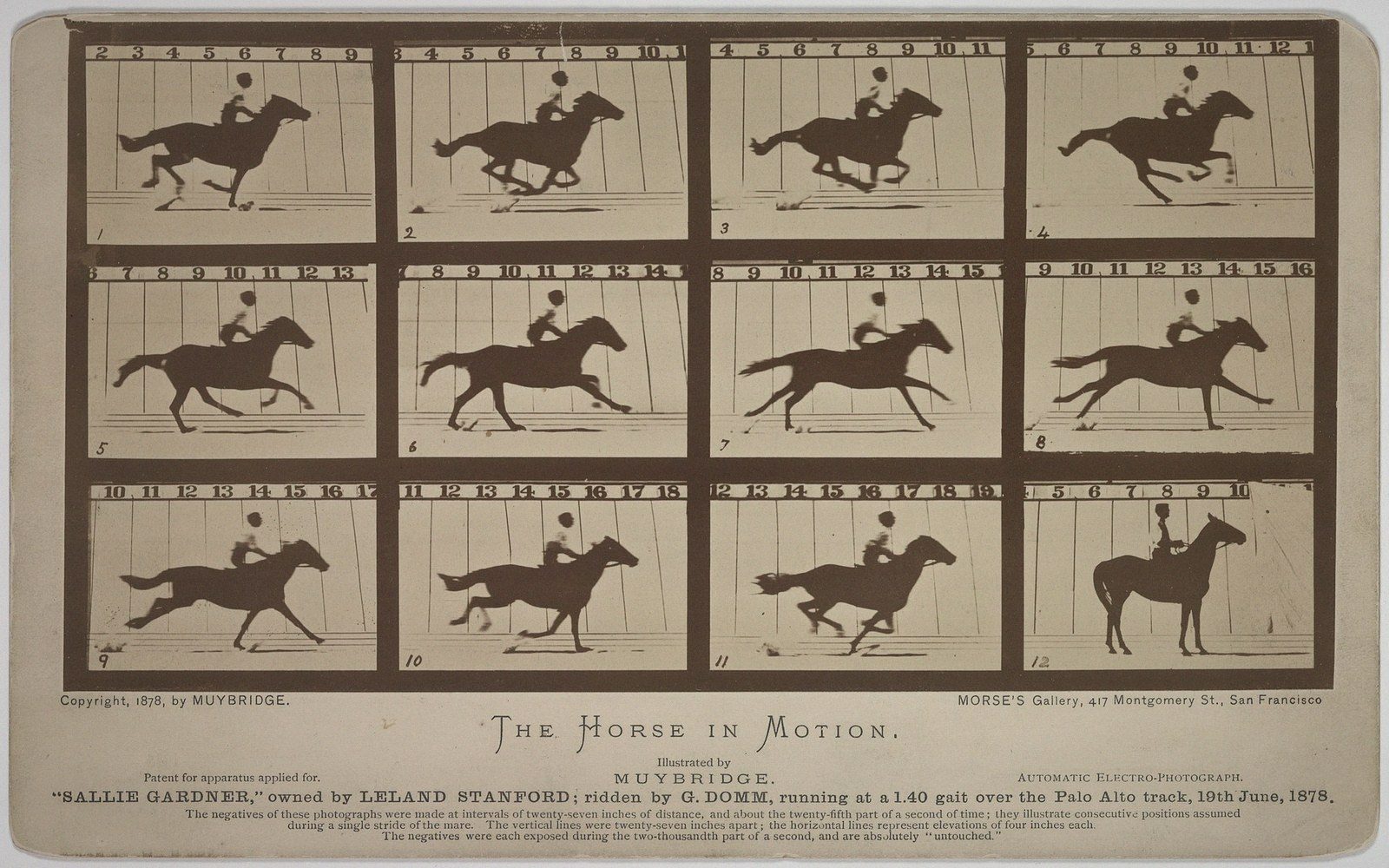
Eadweard Muybridge's 1878 photographs at Sacramento settled what centuries of looking had not. The camera, with its shutter timed in fractions, could arrest the sequence, and what it showed was almost universally counterintuitive. During the suspension phase of the gallop the horse is briefly airborne — but with legs gathered beneath rather than flung wide. The rocking-horse stretch never occurs. Painters who saw Muybridge's contact prints for the first time described them as improbable.
The news moved through studios quickly. Meissonier, who had built a career on military equestrian scenes, had to make a choice and he is reported to have found the correction difficult to accept aesthetically. Ernest Thompson Seton adjusted his work directly. The illustrators and natural historians who were paying attention revised not just horses but dogs, cats, deer — every quadruped whose gait had been painted from accumulated error. The structural logic, once grasped, generalised: each gait has a footfall sequence that obeys mechanical rules, and the rules do not bend for pictorial convenience.
There is still, occasionally, that convention in commercial painting and fast illustration.
What shifted was not anatomy but timing. Artists had always measured the body. Precise measurement of a dead animal had been available for centuries. What they lacked was a method of arresting life at the resolution where motion becomes legible. The camera provided it. After Muybridge, a painter who showed a galloping horse in the splayed-leg heraldic pose was not recording what the eye saw — they were reproducing a convention, and an informed viewer could name it as such.
There is still, occasionally, that convention in commercial painting and fast illustration. It persists because it reads as speed even though it is anatomically inert. Knowing that, you cannot unsee it. The rocking-horse pose, once identified, sits in the picture like a signature: the moment the painter stopped watching and started remembering what galloping is supposed to look like.