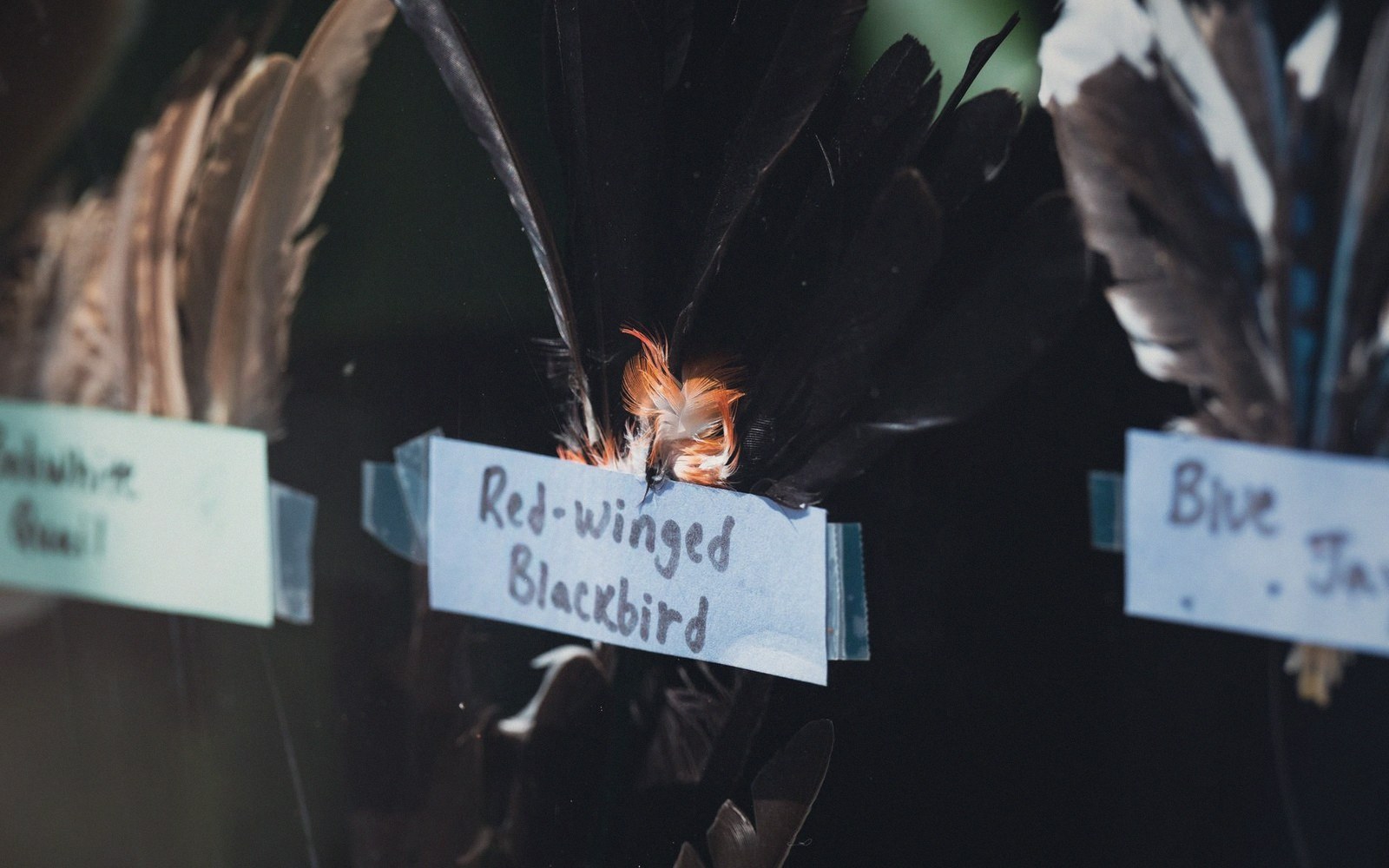
The Natural History Museum has a hundred thousand of them. A painting made from one is almost always subtly wrong.
The errors are consistent enough that, once you know them, you can read a painting and say with reasonable confidence whether it was made from a study skin, from life, or from something in between.
What the skin preserves, and what it destroys
The study skin excels at one thing: it preserves the precise colour and pattern of feathering in a way that a living bird, perpetually moving, rearranging, and partly obscuring itself, will never allow. Draw close enough to a skin in a museum tray and you can see exactly how a tertial overlaps a greater covert, where a supercilium terminates, whether the barring on a flank feather runs across or angled. The feather tracts — the pterylae — are fixed in place. You can measure the outermost primary against the primary projection. You can count scapulars. For an illustrator working to identify species in a field guide, this is genuinely invaluable, and the study skin has served that purpose well for two hundred years.
What it destroys is volume. A living bird is, by proportion, considerably more three-dimensional than people expect. The breast is a deep keel of muscle — the pectoral mass that powers flight constitutes a significant fraction of total body weight in many species. The neck is thick where it enters the mantle. The head sits on that neck with a solidity that is easy to miss when the bird is always turning. The nape swells. The belly, in a perched bird, often drops lower than the wing tips suggest.
A study skin has none of this. Once the body is removed and the skin is stuffed with cotton, the breast flattens. The neck attenuates. The whole silhouette — front to back — compresses. The bird becomes longer and thinner than it ever was in life, because length is what survives when depth is lost: the feathers still cover their original extent of surface area, but now that surface wraps around a form that has no correct volume behind it.
The result, in painting, is a bird that looks stretched. The bill-to-tail measurement may be tolerably accurate. The width — the impression of mass when the bird sits — is wrong, often by a significant margin. Artists who drew primarily from skins tended to make birds that are, subjectively, a hand longer than life: attenuated, slightly heraldic, elegant in a way that live birds rarely are.
The elongation problem and how to spot it
The problem is not uniform across a bird's body, which is what makes it interesting to trace. It concentrates in specific places: the breast, the belly, the lower neck, and — because the skin is typically laid on its back during preparation and dries in that plane — any area where the dorsal and ventral surfaces need to be held apart by volume. The wing, being relatively flat in structure, survives the skinning process in better proportion. The tail, attached to bone and dried under tension, is usually reliable. It is the middle of the bird — the body — that becomes a fiction.
When you look at a painting and find a bird whose wings, when extended, seem perfectly proportioned but whose body between wing-root and vent reads as improbably long, that is almost always a skin. The wingbar pattern is accurate, the scapular arrangement is correct, the primary projection is knowable — all the flat things are fine. But the bird has no mass. It is, in the visual sense, two-dimensional: a pattern pressed onto a silhouette, not a creature with a weight that gravity is pulling toward a branch.
A living perched bird rarely has a straight neck; the head sits forward on an S-curve, the nape raised.
Neck posture is a related tell. In a skin laid flat, the neck straightens. A living perched bird rarely has a straight neck; the head sits forward on an S-curve, the nape raised. Artists working from skins frequently drew the neck too long and too straight — the skin told them that was correct, because in the skin it is.
The specific distortion of the bill is worth noting separately. Skins dry with the bill closed and the gape compressed. In life, even a closed bill carries slight tension at the rictal skin. In skins of species with soft bill-base structures — some warblers, flycatchers — the bill can contract slightly during drying. Artists who drew from skins sometimes made bills fractionally too slender or too blunt at the base. This is a fine distinction, and it matters most in the species where bill shape is a diagnostic character.

The century of the drawer
The great age of the study skin as primary artistic source is broadly the nineteenth century: a period when museum collections were expanding rapidly, when the Linnaean project of classification demanded reference material, when many of the birds being illustrated came from distant continents, dead, in spirit or wrapped in arsenic-salted skins, long before any artist had been near their native habitat. If you worked in London and were illustrating a bird from Borneo, your reference was whatever the Natural History Museum could furnish. That was almost always a skin.
The constraints were real. You could not travel to Borneo. Photography was not yet capable of field work. A skin in a museum drawer was not a choice made in laziness; it was frequently the only option available. Understanding that does not change the visual record it produced — it just explains why so much nineteenth-century bird illustration has that characteristic quality: exquisitely accurate plumage, improbably flat bodies.
John Gould, whose workshop produced thousands of plates across dozens of volumes through the middle of the nineteenth century, worked largely from skins in the collections at what is now the Natural History Museum in London. His paintings are correctly identified for plumage, often beautifully composed, and consistently wrong about avian volume. The birds in many of his plates look as if they have been ironed. This is not a failure of skill; it is a faithful record of the source material.
The artists who best corrected for the skin did so by supplementing it: with living birds in aviaries, with careful observation of the occasional wild bird, with a working knowledge of anatomy that let them restore volume that the skin had removed. Joseph Wolf, who worked in London from the middle of the nineteenth century and was respected by Gould himself, brought something else to his work — a willingness to imagine the muscle behind the feather, to restore the mass that the skin had deleted. His birds sit on their branches differently. They have gravity. Whether Wolf would have described his method that way is another matter, but the pictures make the point themselves.
Reading the skin honestly
The study skin is not a villain. It is a tool with a known characteristic distortion, and an artist who knows that distortion can compensate for it — measuring the skin for colour and pattern while referring to other sources, or simply to knowledge, for volume. The problem arises when the skin is treated as the whole truth: when the painter copies it rather than reading it.
This is the distinction that separates a competent painting from a convincing one. The competent painting transcribes. The convincing painting understands what was transcribed and what was missing, and supplies the missing part from somewhere else — anatomy, live observation, the field sketchbook as a corrective against the drawer.
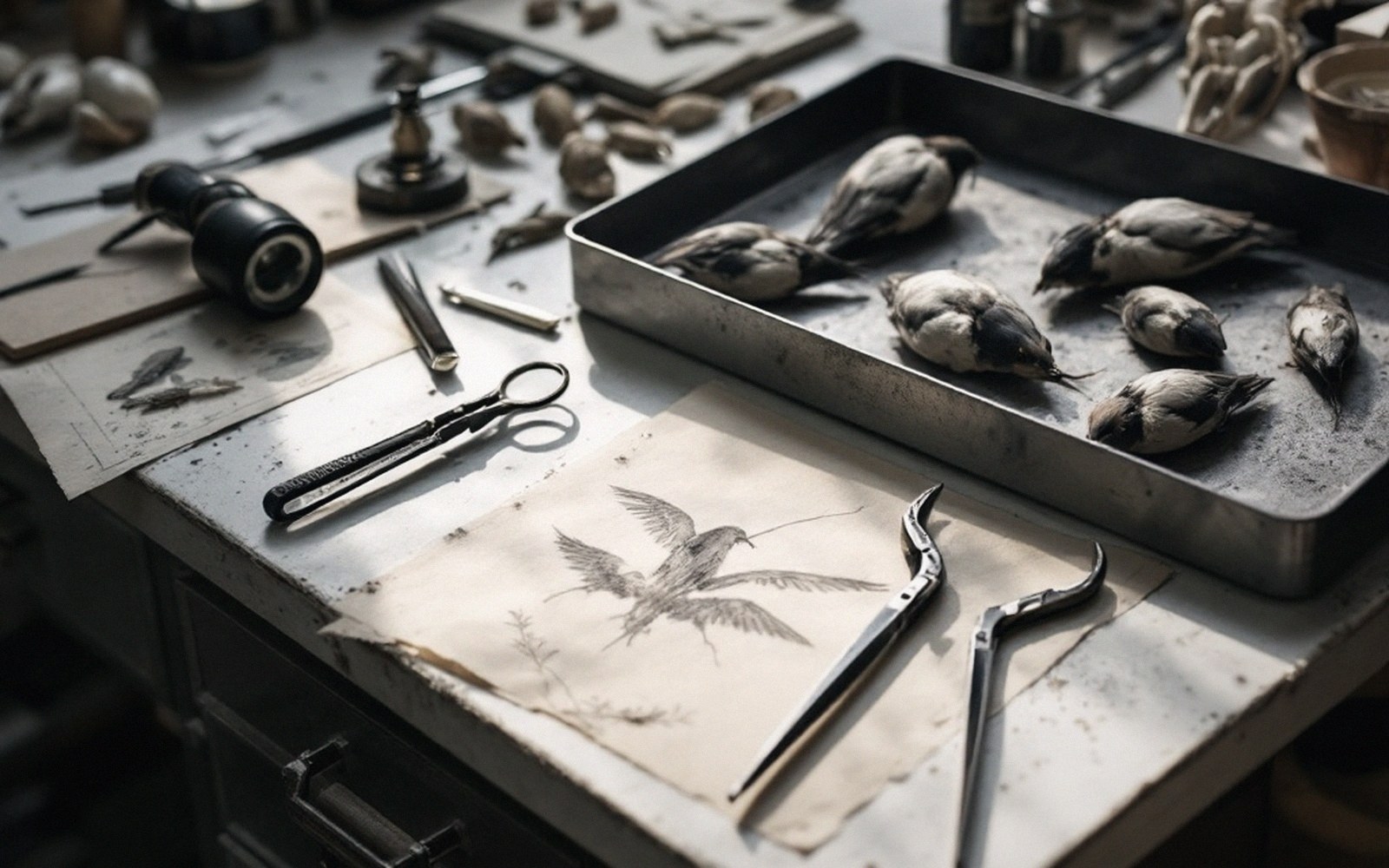
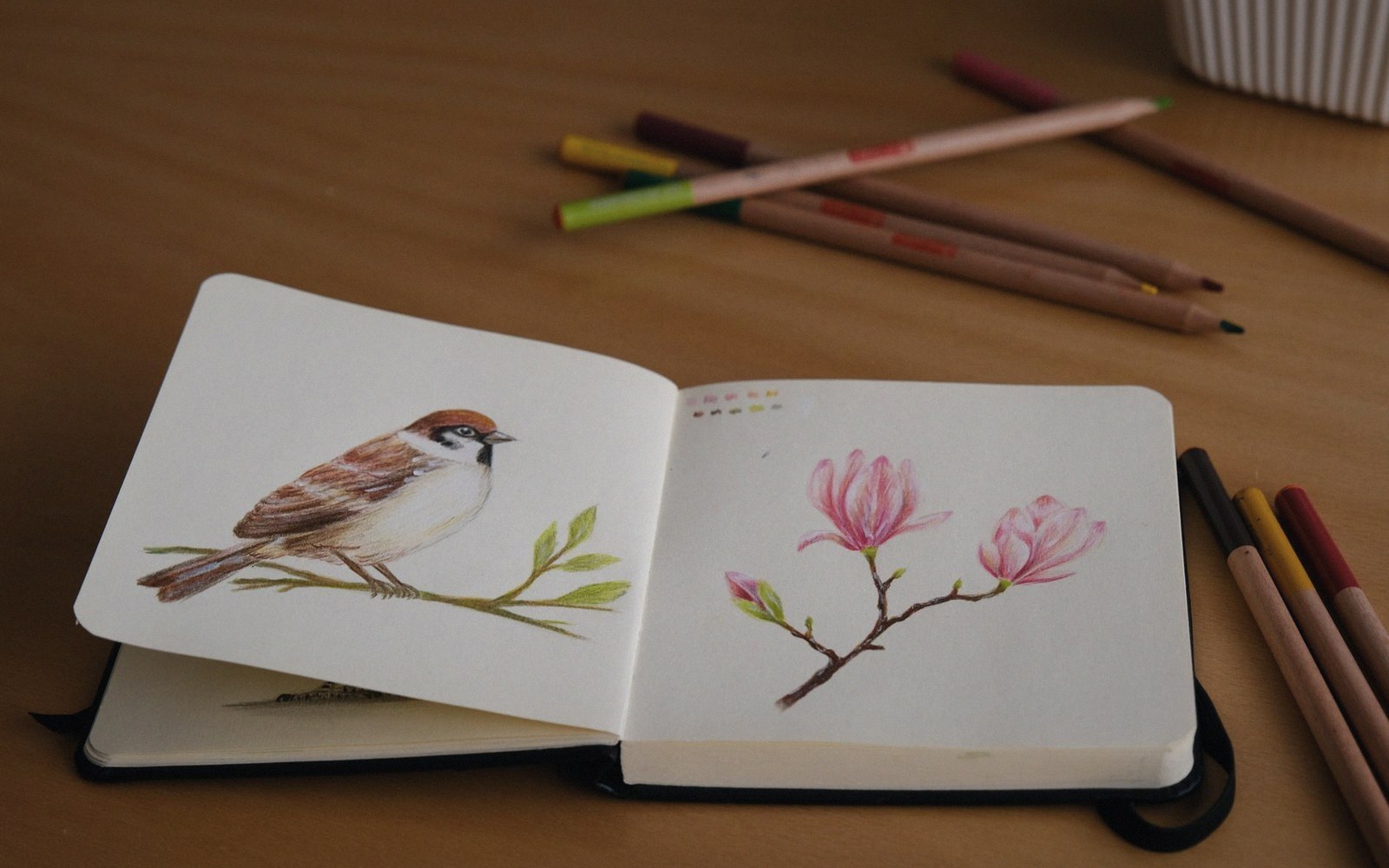
A bird painted only from a skin will have lost its volume the way colour fades from a specimen — the envelope looks right, but something inside it has gone. The painter who knows this can work around it. The painter who doesn't will produce, repeatedly and without knowing why, birds that are a hand longer than life.